Showing posts with label Lake. Show all posts

Sunday, 6 May 2012

Ashtamudi Lake, Kerala, India


Ashtamudi Lake (Ashtamudi Kayal) in the Kollam District of Kerala, India, is the second largest and deepest wetland ecosystem, a palm-shaped (also called octopus-shaped) large water body, next only to the Vembanad estuary ecosystem of the state. Ashtamudi means 'eight coned'(Ashta = 'eight'; mudi = 'coned') in the local language of Malayalam. This name is indicative of the lake's topography: a lake with multiple branches. The lake is also called the gateway to the backwaters of Kerala. 
Ashtamudi Wetland was included in the list of wetlands of international importance, as defined by the Ramsar Convention for the conservation and sustainable utilization of wetland. Along both banks of the lake and its backwater canals, coconut groves and palm trees interspersed with towns and villages are seen. Quilon is an important historic port city located on the right bank of the lake and boat cruises are operated by the Kollam Boat Club from Quilon to Alappuzha providing transport access to many other towns and villages along this route, apart from the luxury “house boats” which also operate in the lake. The boat journey is an 8 hour trip, winds through lakes, canals and water bound villages, and gives a complete exposure to the beauty of the backwaters of Ashtamudi Lake
Chinese fishing nets, called cheena vala in the Malayalam language, are used by local fisherman and are a common sight along the waterway. The lake and the life on its shores have inspired many artists and writers.It has been the subject of many poems of renowned poet Thirunalloor Karunakaran who was born and brought up on its banks.

More Topics: 

Images:


Friday, 6 January 2012

Lake District, England


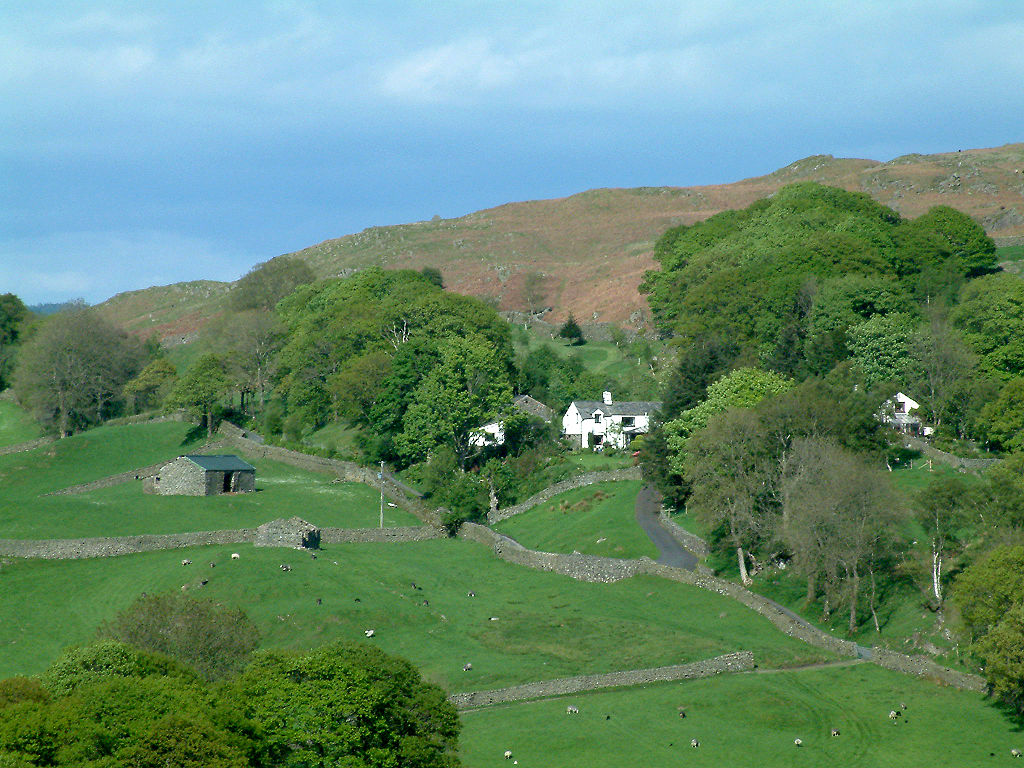
The Lake District, also commonly known as The Lakes or Lakeland, is a mountainous region in North West England. A popular holiday destination, it is famous not only for its lakes and its mountains. The majority of the area was designated as the Lake District National Park in 1951. It is the largest of the thirteen National Parks in England and Wales, and the second largest in the UK , It lies entirely within the modern county of Cumbria, shared historically by the counties of Cumberland, Westmorland and Lancashire. All the land in England higher than three thousand feet above sea level lies within the National Park, including Scafell Pike, the highest mountain in England. It also contains the deepest and longest lakes in England.

The precise extent of the Lake District was not defined traditionally but is approximated by the boundary of the National Park, the total area of which is about 885 square miles (2,292 km2). The Park extends just over 32 miles (52 km) from east to west and nearly 40 miles (64 km) from north to south,with areas such as the Lake District Peninsulas to the south lying outside the National Park.

Some Important Topics:-

Images:  


Thursday, 5 January 2012

Masurian Lake District, Poland

The Masurian Lake District or Masurian Lakeland  is a lake district in northeastern Poland containing more than 2,000 lakes. It extends roughly 290 km eastwards from the lower Vistula River to the Poland-Lithuania border and occupies an area of roughly 52,000 square kilometers. The lake district was shaped by the Pleistocene ice age. Many of its hills are parts of moraines and many of its lakes are moraine-dammed lakes. The lakes are well connected by rivers and canals, forming an extensive system of waterways. The 18th-century Masurian Canal links this system to the Baltic Sea.

The lake district was shaped by the Pleistocene ice age. Many of its hills are parts of moraines and many of its lakes are moraine-dammed lakes. From 13th century on, the Lakeland was successively part of the monastic state of the Teutonic Knights, the Duchy of Prussia, and the Prussian province of East Prussia. In modern times, while part of the German Empire, it was the location of the First Battle of the Masurian Lakes (1914) and the Second Battle of the Masurian Lakes (1915) during World War I. At the end of World War II (1945), following the decision taken at the Potsdam Agreement, all national borders were redrawn and the area ceded to Poland.

Masuria has a temperate climate with cold winters and warm summers. The weather here is cooler than in most parts of Poland, and the area also has some snow during the winter. The Masurian lakes are usually frozen from December to the end of April. Springtime can be wet, while summers are generally drier.

Images: